





Let's Go West Part III: How do You Obtain a Tag?
In the last article, we broke down the pros and cons of mule deer and elk in an effort to help you decide what species you want to pursue on your first western big game hunt. Hopefully, you have an idea in your head now, and we can start to develop a plan for that species. The next step is figuring out what your tag options are. With this being your first hunt, we are going to look specifically at states and units that have easy-to-draw tags. Currently, there are very few over-the-counter options for mule deer or elk, but there are units that can be drawn often. The other thing to consider is a good application strategy that allows you to make that return trip and capitalize on the knowledge you’ve obtained.

When it comes to elk hunting, there are a handful of good choices for your first opportunity. Colorado, Montana, Wyoming, and Idaho are going to be your best options for obtaining a tag. Colorado has recently gotten rid of their OTC archery hunts for nonresidents, but many of those units can be drawn with 100% odds. There are still a bunch of rifle OTC opportunities during the 2nd and 3rd seasons. Montana has a nonresident draw for elk and deer tags. For the sake of this article, I’m going to stick with Montana’s general units, as it has a very confusing process for limited entry tags. 75% of tags go to people with the most points, and the remaining 25% are drawn from the 0-point pool. I help several guys apply in Montana and typically tell them to skip the points altogether and apply with zero. They seem to draw a tag about 50% of the time. Idaho has a draw for its general tags that takes place in December. This is the first year, and we really don’t know what to expect for draw odds. Hopefully, people understand that these tags aren’t highly sought after, and Idaho will remain easy to draw. Wyoming is all about points. Some tags can be drawn with 0-2, and others that take years. The general hunts in Wyoming provide a great balance of opportunity and trophy quality. They limit them enough that many people consider Wyoming to be the best bang for your buck with elk hunting. Elk tags are more expensive than mule deer, and the cost can be prohibitive at times.
Below are the four states with the most opportunity and the costs associated with an elk license/tag.
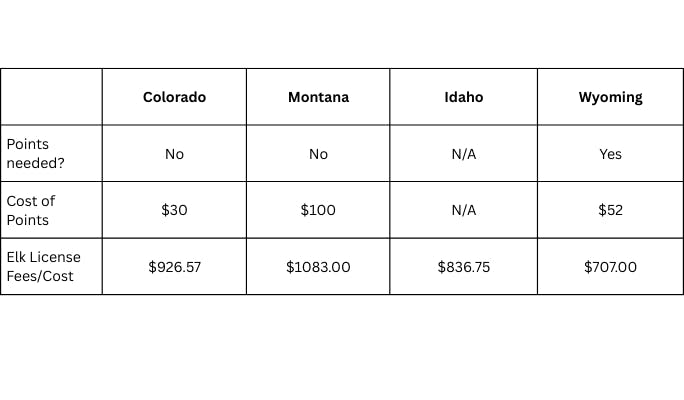
One thing I don’t recommend is choosing a state strictly based on price. It appears that Wyoming is the cheapest state, but that comes with the fact that you can only draw a general tag every 2-6 years. It would be much better to plan a Colorado hunt that would allow you to come back year after year or as often as you want to. Application strategies can get complicated as you develop points in more states. The key to becoming a successful elk hunter is to get as many opportunities as possible. That could mean hunting every year, or it could mean hunting every couple of years in a slightly better unit with a better chance for opportunities.

Currently, there are a bunch of good opportunities to hunt mule deer as well. Mule deer numbers have been declining for a long time now, but recent management changes and favorable weather have helped them bounce back in some areas. Almost every state has a good option to obtain a tag for mule deer. There are easy-to-draw hunts that are managed for opportunity, and other units that are managed for more mature bucks. I’d recommend finding a unit or area that can be obtained often while building an application strategy to draw more coveted tags in 5-10 years. Those tags won’t be the elite units that offer very few tags, but in many cases, they are a step above general or low-point units. Below are states that fit the criteria for this article:

I included Arizona archery deer hunts in this graphic, as they are a good opportunity and can be hunted while you build points in other states. Most Arizona rifle hunts are tough to draw and can take decades of points to draw. Unless you are planning on hunting several other species, I would avoid building points in Arizona just for mule deer.
Idaho and New Mexico do not have point systems. While this doesn’t reward you for putting in year after year, it does allow for a lot of flexibility. If you are busy one year and won’t have time to hunt those states, you can skip the draw without feeling like you are falling behind. Colorado, Montana, and Wyoming can be drawn with low points and should probably be staggered out to make sure you can maximize whatever opportunity you do have. Out of all these states, Colorado typically produces the most mature bucks. There is a combination of factors here, but healthy populations, season structure, and good habitat help Colorado be a leader for mule deer. Montana offers a great opportunity to harvest a buck, but the age class is low, and finding mature deer can be challenging. Wyoming offers a bunch of different hunts. They have low-country badlands-type hunts and some of the most rugged high country in the lower 48. I personally prefer to build a few points in Wyoming and hunt their high-country units in years where the deer herds are healthy.
When you start to plan your hunt, you’ll be full of questions and excitement. Every unit will have something intriguing about it, and the different season dates will provide you with ample opportunities. Don’t get caught up in the excitement. Make sure you start with a plan and execute it. Pick your species, pick your season, find the state and unit you are interested in, and determine how often you can obtain a tag. A tag application strategy will quickly come into play. You’ll realize there are a ton of options and probably want multiple different tags every year. If you don’t have a ton of time to dedicate to hunting, be sure to prioritize your time and maximize one or two opportunities a year. It sounds fun to have three mule deer tags and two elk tags in a year, but it can be stressful, and oftentimes it doesn’t play out as well as you’d like.